A common criticism of Bitcoin is that it can be used by criminals for money laundering, illegal commerce, and ransomware.
While it is possible to use Bitcoin for anything, using it for crime is a remarkably poor choice because transactions are recorded permanently on a public ledger. What criminal would want to leave permanent evidence?
Criminals using bitcoin can be caught by law enforcement agencies through the use of blockchain analysis tools. As a result, the data now shows that Bitcoin accounts for only a small fraction of illicit activity.
The myth of bitcoin as criminal money
The association between Bitcoin and crime traces back to the early 2010s, when darknet marketplaces like the Silk Road used bitcoin as a primary means of payment. At the time, bitcoin was a relatively new and unregulated asset. Law enforcement did not yet have the tools to trace transactions associated with crimes.

By 2020, blockchain analysis advanced to a point where using bitcoin for illicit activity no longer made sense. This is because Bitcoin is pseudonymous. While addresses are not directly tied to real-world identities, every transaction is recorded forever on a public ledger that anyone can inspect. Once an address is linked to a person, these analysis tools can be used to attempt to reverse engineer their transaction history.
The data behind bitcoin and financial crime
The most comprehensive data on illicit bitcoin and crypto activity comes from blockchain analysis firm Chainalysis, which publishes an annual Crypto Crime Report used by governments and law enforcement worldwide.
It is worth noting that these figures are estimates, not proof. Chainalysis’ methods have real limits due to the difficulty of tagging and verifying the true source of wallets. Treat the numbers below as rough estimates.
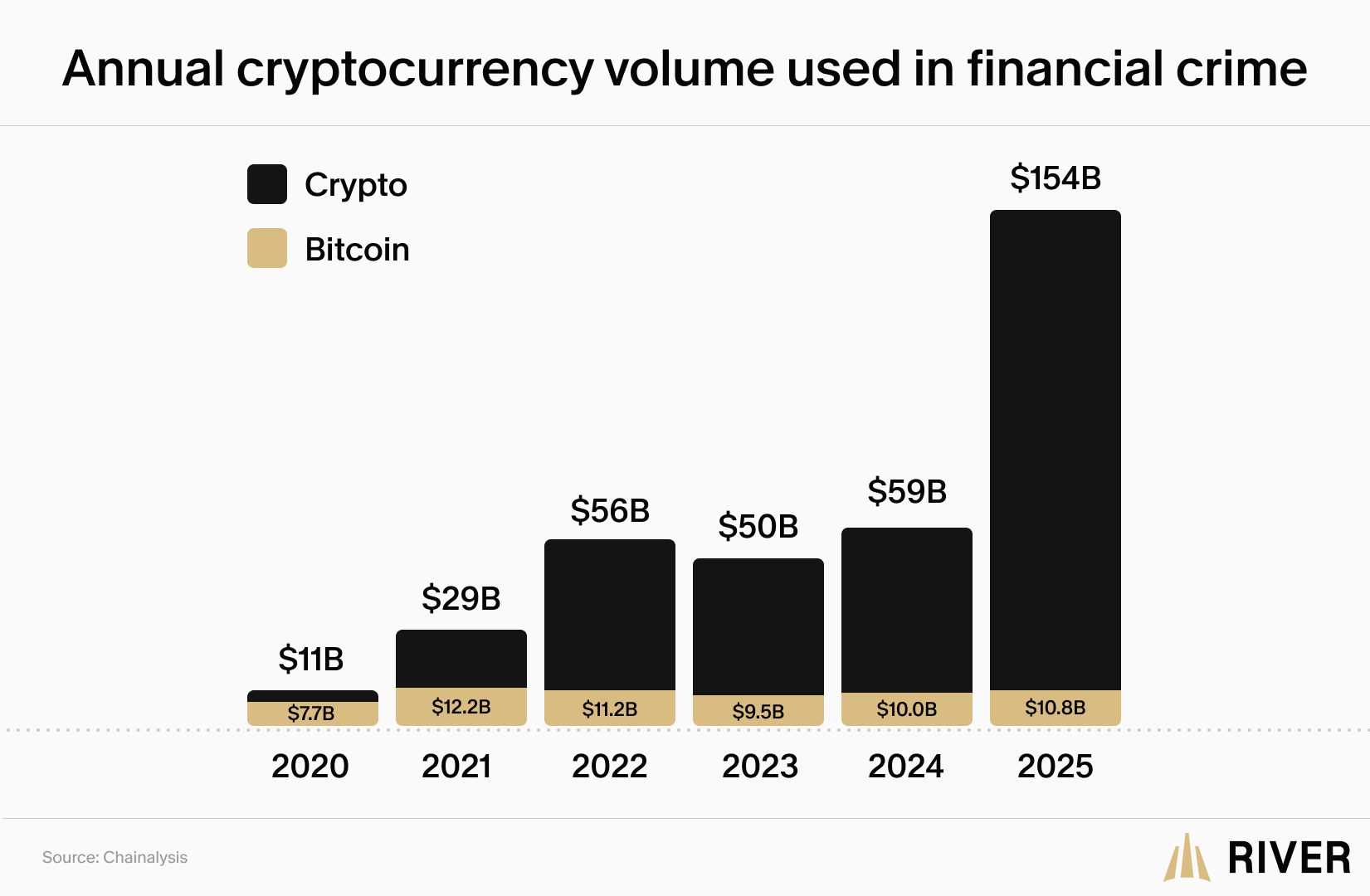
According to the data, illicit activity represents a tiny share of all bitcoin transactions. In 2025, illicit activity made up less than 0.1% of total bitcoin transaction volume.
To put this into context, money laundering and financial crime makes up 2-5% of global GDP, according to the United Nations. This represents more than $2 trillion each year. Bitcoin makes up just 0.4% of this amount.
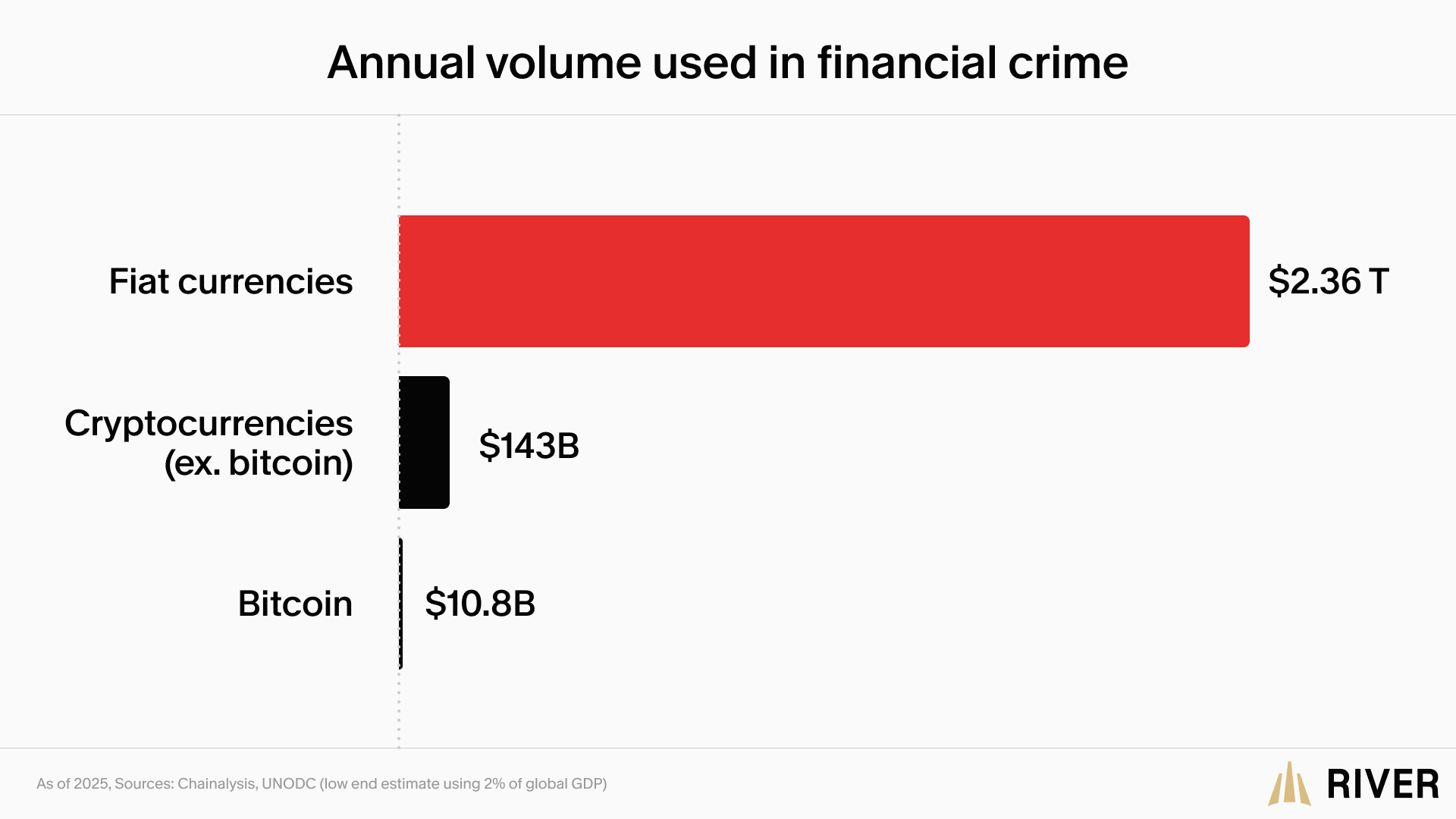
Other cryptocurrencies, particularly stablecoins, have grown in popularity for illicit transactions, even though their share of total financial crime volume remains small. By contrast, usage of bitcoin for financial crime has been on a slight downtrend since 2021.
Criminals prefer cash and traditional banking over bitcoin
The vast majority of financial crime flows through cash and the conventional banking system, not bitcoin or cryptocurrencies.
Europol, the European Union’s law enforcement agency, has repeatedly made this point. It reports that cryptocurrency transactions linked to criminal activity represent only a limited share of the criminal economy when compared to cash and other traditional payment methods. The agency also noted that, unlike cash, bitcoin and other cryptocurrencies actually give investigators access to far more information, because every transaction is logged on a blockchain.
Cash remains the preferred instrument for laundering criminal proceeds precisely because it offers what bitcoin cannot: genuine anonymity and no permanent record. Cash transactions are recorded nowhere, whereas bitcoin transactions are recorded forever.
Bitcoin as a tool for law enforcement
Perhaps the most counterintuitive consequence of bitcoin’s transparency is that it has become a valuable tool for law enforcement rather than an obstacle.
Because the blockchain is public and permanent, investigators can trace the flow of funds in ways that are impossible with cash. High-profile cases have demonstrated this repeatedly: authorities have recovered ransom payments, dismantled darknet marketplaces, and traced funds tied to exploitation, all by following transactions on the blockchain. When criminals do use bitcoin, they frequently leave behind a trail of evidence that leads directly to them.
Unfortunately, these investigative tools have also led to false positives, accusing innocent people. Their output should be evaluated with caution.
Bitcoin as a tool for sanctions evasion
While bitcoin is unpopular for financial crime, it is growing in popularity among nation-states who are cut off from the global financial system. Countries such as Iran, Russia, and North Korea hold and use bitcoin to move and store money outside the reach of any foreign government.
But this fact highlights a key value of bitcoin, rather than a downside: When stored in self-custody, bitcoin cannot be frozen or seized remotely the way a bank account or foreign-held reserve can.
The same property that frustrates a foreign government’s ability to freeze funds is what makes bitcoin valuable to dissidents, journalists, and ordinary people living under capital controls, authoritarian rule, or a collapsing national currency. Bitcoin does not care about the identity or intentions of its users. It settles transactions according to its rules, and no outside party can reverse or block them.
Bitcoin’s transparency is a feature, not a contradiction
It may seem paradoxical that an asset so traceable could also be called incorruptible and immutable money. But these properties are not in tension. Bitcoin’s transparency is what makes it trustworthy, because every transaction is recorded on a public ledger that no one can alter. No government, bank, or individual can secretly inflate the supply, reverse a payment, or rewrite the record. The same openness that lets investigators follow illicit funds is what lets anyone, anywhere, verify the entire monetary system for themselves.
Bitcoin offers fair and predictable rules to everyone. These rules cannot be quietly changed, which is precisely why it resists corruption and censorship even as it remains auditable. Critics who describe bitcoin as criminal money are mistaking transparency for a weakness. In reality, it is one of Bitcoin’s core values: a form of money whose history is permanent, whose supply is fixed, and whose ledger is available to anyone.