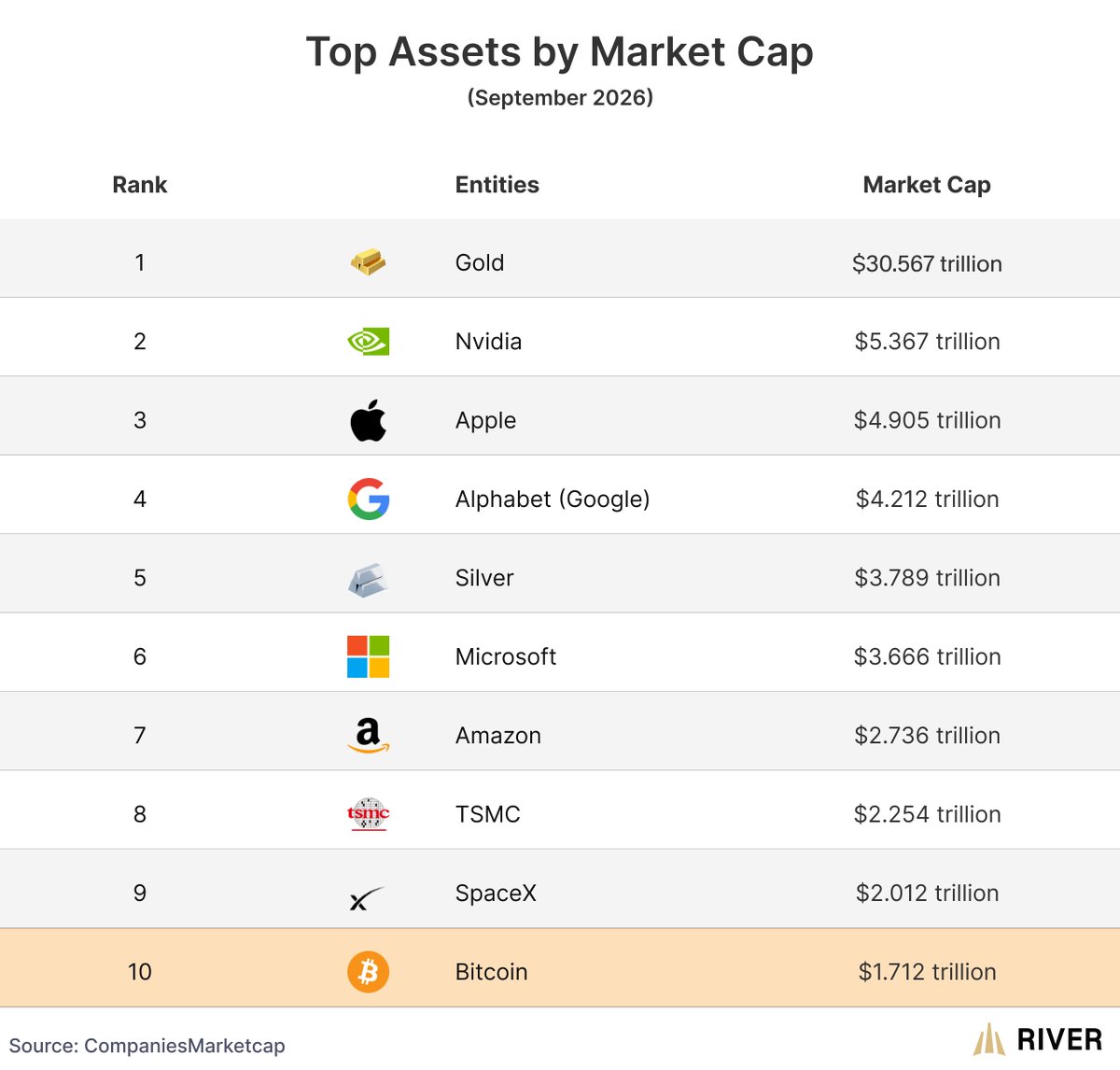
A majority of investors have yet to follow Wall Street’s guidance of a 1-7% bitcoin allocation. What happens when they do? This analysis models out the bitcoin price implications over the next three to five years.
Owning bitcoin is becoming normal.
We begin with a brief update on where bitcoin adoption stands today.
Roughly 4% of people worldwide own any bitcoin. Those who do tend to hold small amounts, and few treat it as a core part of their portfolio.
Institutional investors, who manage 50% of global financial wealth, began making meaningful allocations to bitcoin in 2024 after the launch of Bitcoin ETFs. Today, investment advisors as a whole have just a 0.008% allocation to bitcoin.
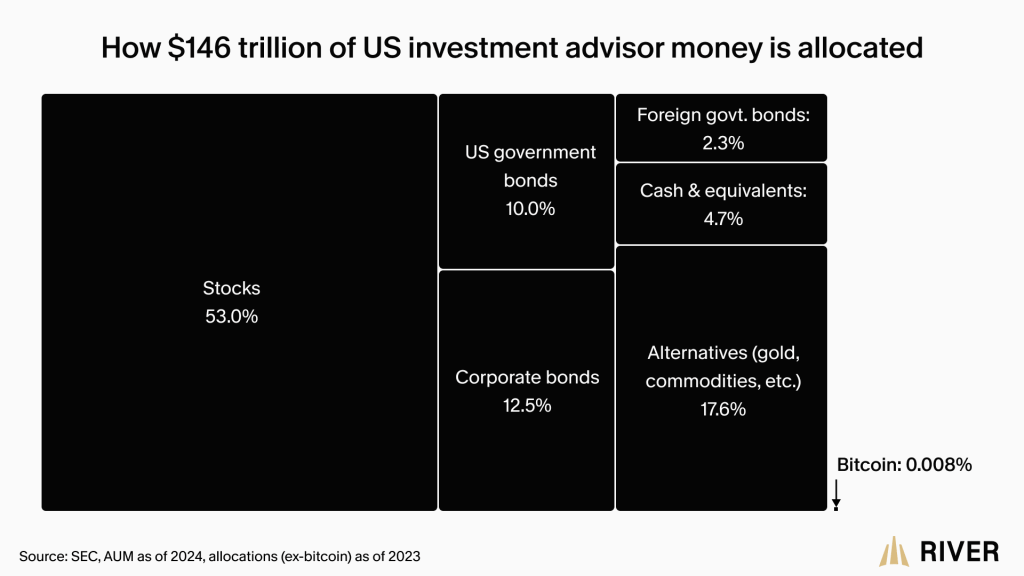
But this allocation is beginning to change. Bitcoin is now widely considered to be a valuable addition to most investment portfolios.
In the United States, 29 of the top 30 Registered Investment Advisors (RIAs) now own bitcoin. The median allocation remains small at 0.10%, but is steadily growing each year.

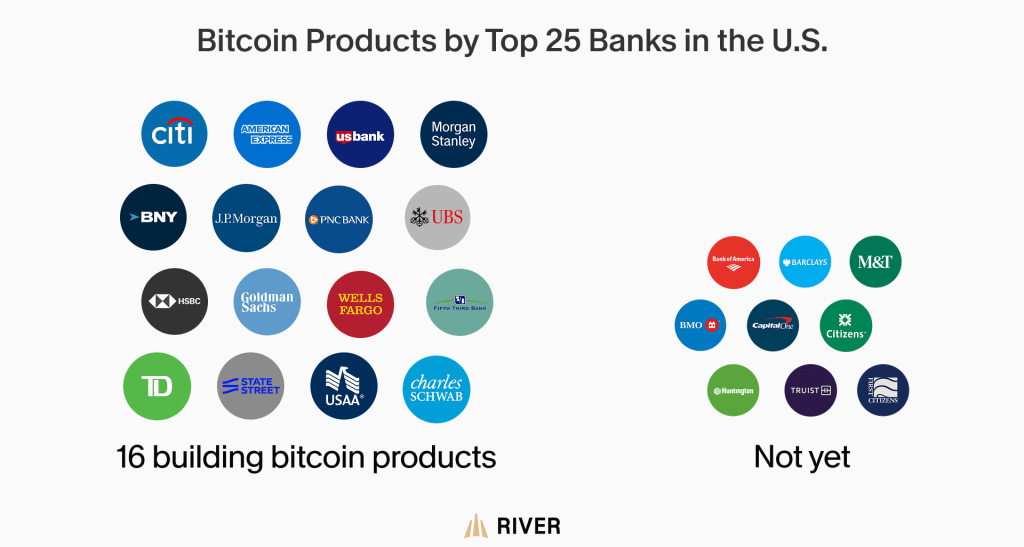
A majority of the top banks are now building bitcoin products for their clients.
Wall Street now stands to benefit from bitcoin adoption. They no longer have a reason to steer clients away from it. The most well-established financial institutions recently began recommending meaningful bitcoin allocations to their clients.
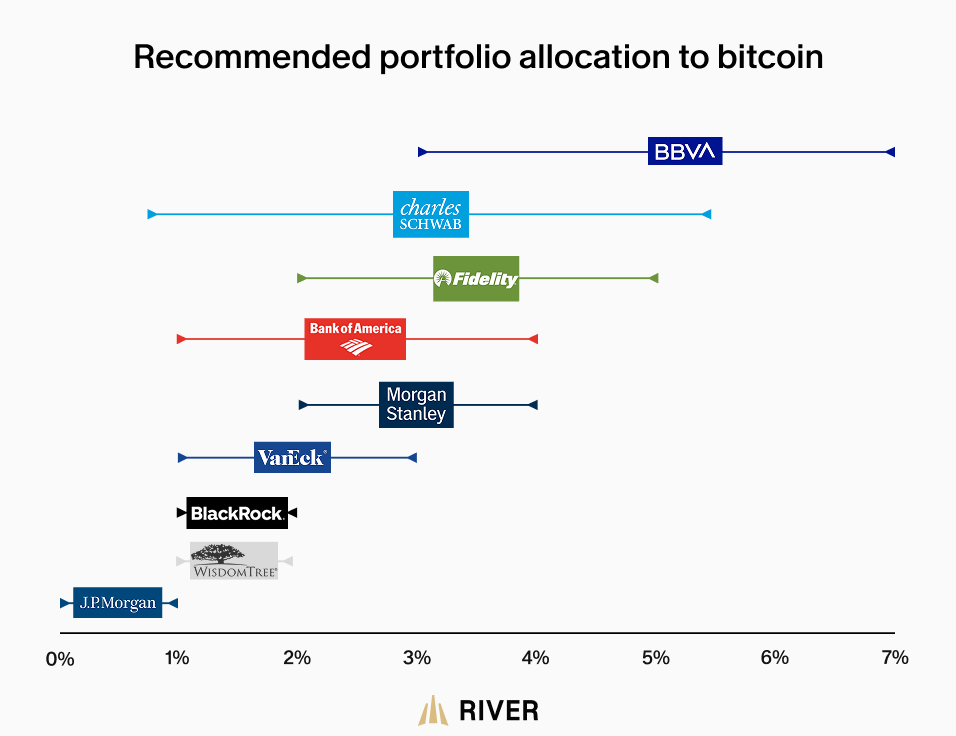
The world’s largest financial institutions are telling people to buy an asset that almost no one owns, with a supply that cannot expand to meet them. Increased demand for a fixed-supply asset can only be resolved in one way: through price.
Modeling the effect of capital inflows on bitcoin’s price
Growing ownership of bitcoin has price implications, which are modeled below by estimating two numbers:
- Capital inflows into bitcoin
- How much each dollar of inflow moves bitcoin’s market value
Capital inflows depend on two things: how many existing and additional portfolios add bitcoin, and how large those allocations are.
Financial advisors, who manage roughly 40% of all wealth in America, are adopting bitcoin quickly. According to a survey by Bitwise, the share of advisors allocating to crypto (of which bitcoin is the largest component) rose from 22% in 2024 to 32% in 2025. 56% plan to add it or are considering it. It must be noted that the average bitcoin allocation among these advisors remains very small at less than 0.1%.
If adoption grows at even half its 2025 pace, 45–55% of advisors would be allocating within three to five years.
We use a more conservative range of 20–40% of portfolios, because adoption is less certain among investors who don’t use advisors, and among investors outside the United States.
We estimate these portfolios will, over time, make average allocations of 2–4% to bitcoin, in line with guidance from Wall Street’s largest firms.
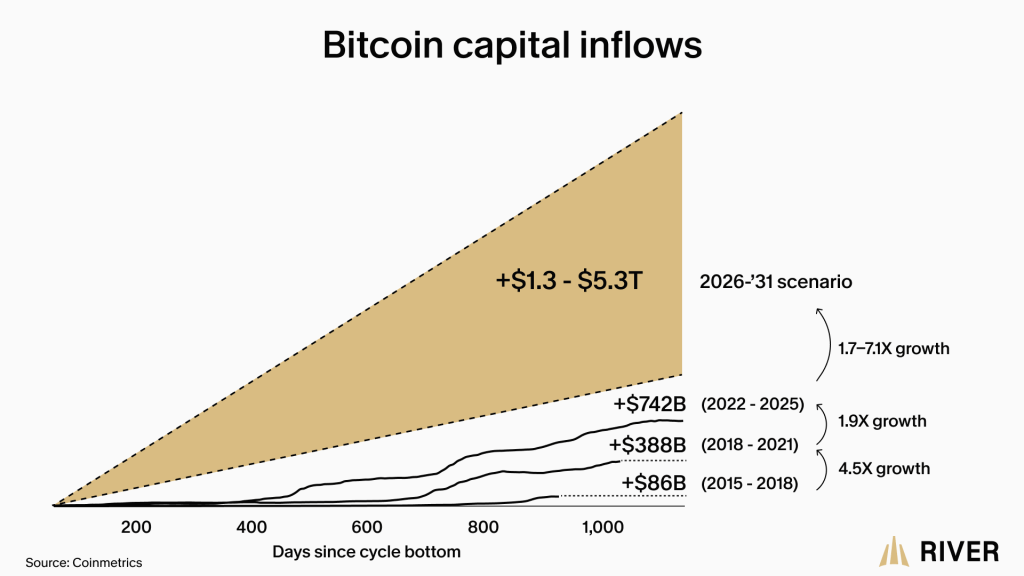
Against a global financial asset base of roughly $333 trillion, that implies $1.3–5.3 trillion of net inflows over the next three to five years.
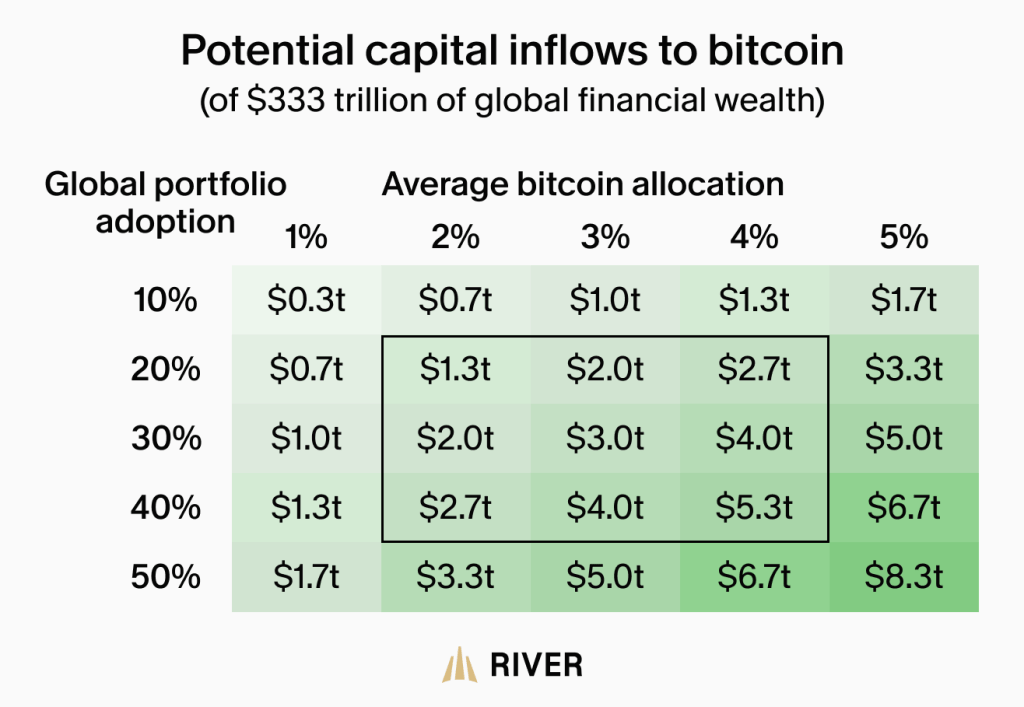
This range lines up with the growth in capital inflows across bitcoin’s previous bull markets, as shown in the chart below.
The implications for bitcoin’s price
Financial markets are not perfectly elastic: when new money enters an asset and existing holders don’t sell, prices must rise by more than the inflow itself. Economists Xavier Gabaix and Ralph Koijen found that every $1 invested in the US stock market raises its total value by roughly $5.
Bitcoin shows the same pattern. $1 of net inflows produced $4.50 of market value growth in 2015–2017, $3.30 in 2018–2021, and $3.10 in 2022-2025. Over the next three to five years, we assume bitcoin’s market value will grow by $3 for every $1 of net inflows.
At a 3X multiple, inflows of $1.3-5.3 trillion imply a bitcoin market value of $5.5–17.5 trillion. This equates to roughly $250,000 to $840,000 per coin, with the low end requiring nothing more than the current pace of adoption continuing.
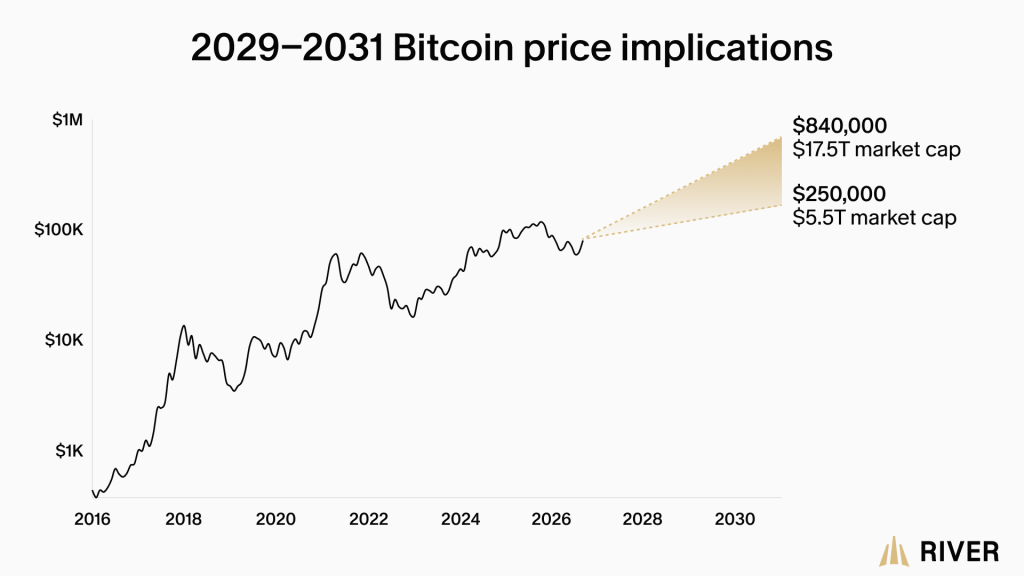
This price model relies on simple assumptions that could prove wrong for multiple reasons. Capital inflows to bitcoin (and bitcoin’s corresponding price) could fall short of, or exceed, the ranges indicated in this analysis.
Furthermore, financial markets are highly complex and difficult to predict. The financial landscape is becoming increasingly uncertain as a result of technological progress, geopolitical conflict, and fiscal fragility, among other factors.
But one thing remains the same: the Bitcoin protocol continues to operate as originally designed 18 years ago. Bitcoin continues to be the most transparent and scarce form of money ever created, and its adoption continues to spread at a steady pace.
River does not provide investment, financial, tax, or legal advice. The information provided is general and illustrative in nature, is not a recommendation to buy or sell any asset, and should not be relied upon for tax or investment decisions. Bitcoin and other assets are volatile and may lose value. Past performance is no guarantee of future results. Hypothetical portfolio results do not represent actual trading and do not account for taxes or fees. Consult an appropriate professional regarding your individual circumstances.