Every day, you are being sold financial products where the odds are heavily stacked against you.
96% of Americans are destroying their wealth with at least one of these investments.
1. Leveraged ETFs
Leveraged ETFs give investors amplified exposure to a stock or index (usually 2x or 3x). $TQQQ, for example, provides 3x the daily performance of the NASDAQ-100.
Historically, these products bleed value over time. If an ETF amplifies a stock’s returns by 3x, a 17% downswing cuts the value of the ETF in half, meaning you’ll need to double your money just to get out of a loss.
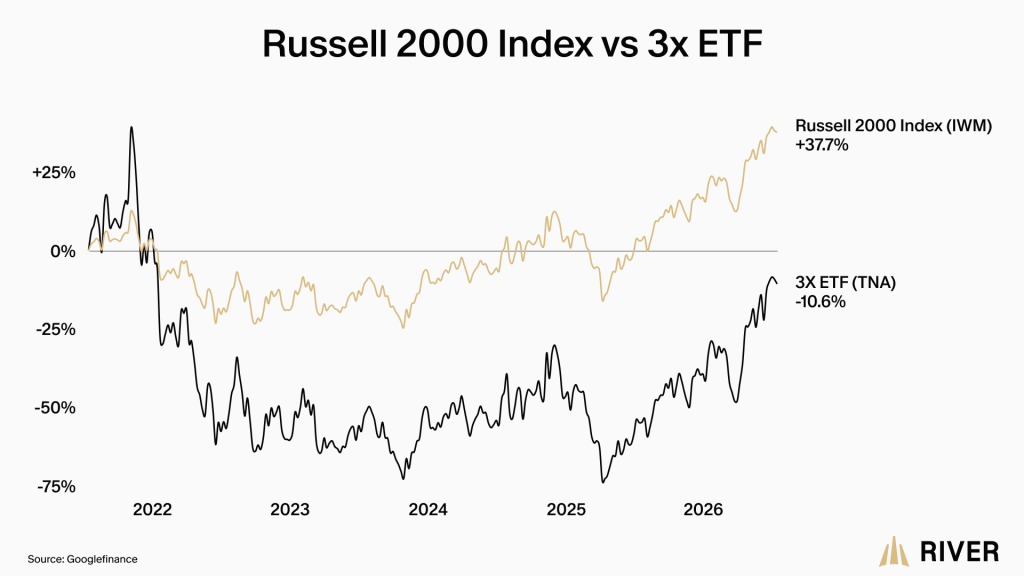
The chart below shows this in action; the Russell 2000 Index has risen by 37.7% over the past five years, while its 3x ETF (TNA) has fallen by 10.6%.
2. Crypto
Crypto is notorious for pump-and-dump schemes, insider collusion, and scams. In the past few years, it has become trivial to create a cryptocurrency and subsequently dump it on unsuspecting investors.
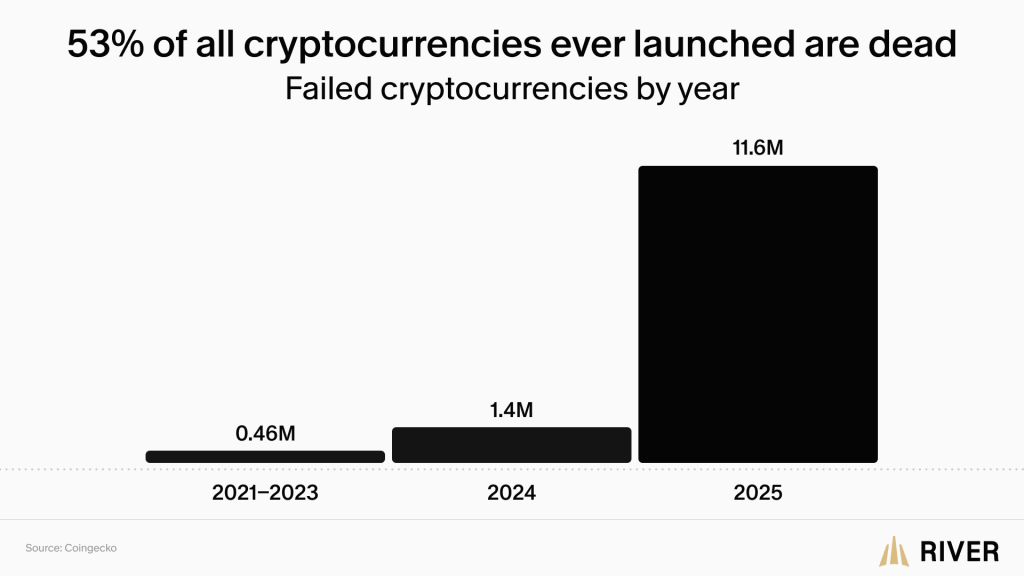
Of the roughly 20 million tokens launched since 2021, CoinGecko found more than half have lost 100% of their value.
Of the top 100 cryptocurrencies in 2021, 89 are worth less today. On average, they lost 56% of their value in five years.
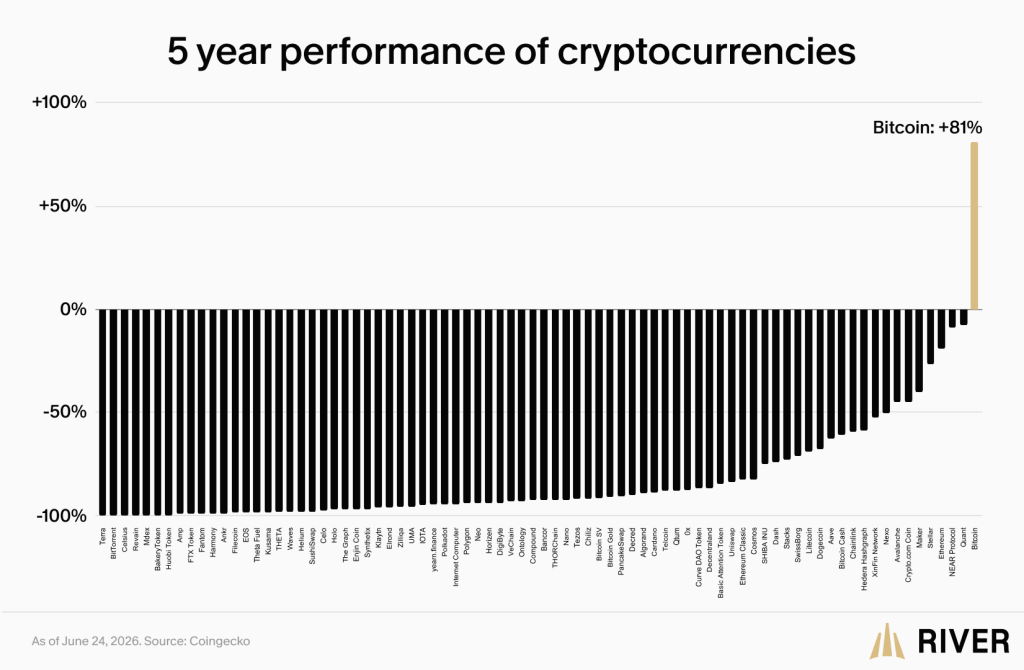
Bitcoin is different.
Most tokens are launched by a company or team that keeps a large portion of the supply to themselves. This makes pump-and-dump schemes possible, where these insiders sell their tokens to unsuspecting investors.
Bitcoin never had that structure. Its pseudonymous creator Satoshi Nakamoto released the code publicly in January 2009 before disappearing two years later. There was no company, no pre-sale, and no insider allocation.
No one controls Bitcoin today, either. Its rules are enforced by open-source code and verified by tens of thousands of independent computers around the world. No executive can change the fact that bitcoin has a fixed supply of 21 million coins.
Bitcoin has now operated continuously for 17 years and is held around the world by individuals, funds, and publicly traded companies. Over the past decade, bitcoin has appreciated by an average of 58% per year. That track record is why serious investors treat bitcoin as a store of value and the rest of crypto as speculation.
3. Prediction markets
There are only two types of people who benefit from prediction markets:
- Insiders, who can consistently make money by exploiting an informational advantage, such as the U.S. Special Forces soldier who made nearly $400,000 by betting on Nicolas Maduro leaving office. He knew this would happen given his involvement in Maduro’s capture.
- Outside observers, who do not place any bets, but benefit simply by knowing the real-time odds of any particular event happening.
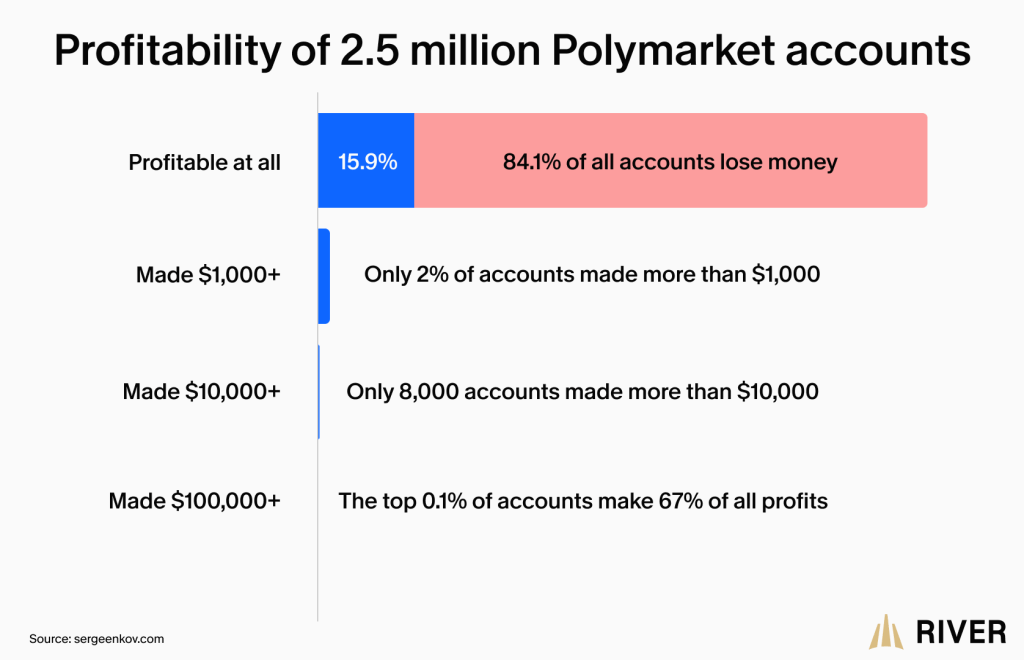
Almost everyone else loses money. 70-84% of accounts on Kalshi and Polymarket have losses, while 67% of all profits on these platforms come from fewer than 2,000 accounts, according to the Wall Street Journal and independent researcher Andrey Sergeenkov.
4. Options contracts
Investment apps today eagerly push options on their inexperienced customers.
These individuals hope to make home-run trades, but options are really meant for institutional investors, who use them to manage risk by taking small positions to hedge against downside scenarios.
Individuals who trade options pay for it with high fees (6.5%-11.8% per trade) and consistent losses (4% to 16% per trade), according to the Journal of Finance and the University of Florida.
This amounts to billions of dollars every year flowing from individuals back to Wall Street.
5. Cash in a bank account
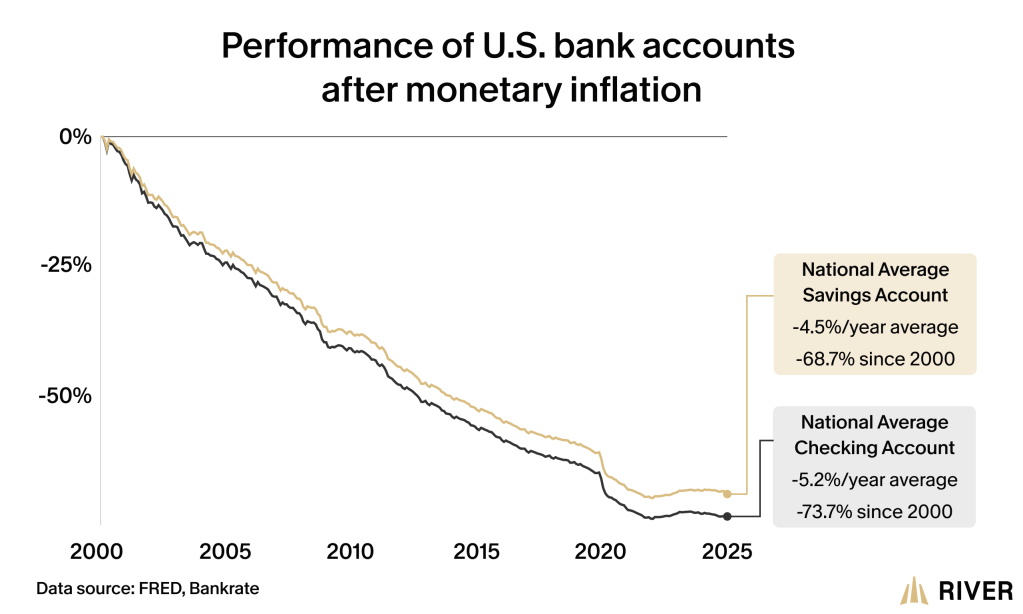
Banks in the United States used to pay high interest rates to their depositors. Today, the average interest rate for a checking account is less than 0.1%, while savings accounts pay just 0.6%.
With inflation, that means your money in a bank loses purchasing power every year at a compounding rate. Since 2000, cash in the average bank account has lost more than 68% of its value.
So, what should you invest in?
Passive investing beats active investing for most people. Historically, what makes sense is finding long-term investments, allocating your savings to them regularly, and not overthinking it.
Invest in things that don’t get eroded by inflation. Cash may feel safe, and it’s responsible to always keep some cash on hand for emergencies. Over the long term, consider keeping your savings in a broad basket of stocks, or hard assets like bitcoin and gold.
River does not provide investment, financial, tax, or legal advice. The information provided is general and illustrative in nature, is not a recommendation to buy or sell any asset, and should not be relied upon for tax or investment decisions. Bitcoin and other assets are volatile and may lose value. Past performance is no guarantee of future results. Hypothetical portfolio results do not represent actual trading and do not account for taxes or fees. Consult an appropriate professional regarding your individual circumstances.